
Table of Contents
- Clothing Store Restock Schedule: What to Actually Expect
- How Often Do Clothing Trends Change in 2026?
- Fast Fashion Inventory Turnover and What It Means for Shoppers
- How Trendy Stores Update Smarter: A Sustainability-Focused Approach
Last Updated: August 11, 2026
Clothing Store Restock Schedule: What to Actually Expect
How often trendy stores update their inventory depends entirely on store type, and the gap between fastest and slowest is wider than most shoppers realize.
A clothing store restock schedule is the planned cycle by which a retailer refreshes inventory by adding new styles, retiring old ones, or rotating seasonal collections. The cadence varies dramatically across retail formats.
Store Type |
Typical Restock Frequency |
What Drives It |
|---|---|---|
Fast fashion chains |
Weekly or bi-weekly |
High inventory turnover, trend-chasing |
Mid-tier retail |
Monthly or seasonal |
Planned seasonal collections |
Boutique / curated |
Bi-weekly drops or seasonal |
Curated merchandising strategy |
E-commerce specialty |
Ongoing, rolling additions |
Consumer demand, supply chain speed |
The common mistake is assuming all trendy stores operate on the same schedule. A boutique dropping a curated edit every two weeks runs a fundamentally different retail cadence than a mass retailer pushing new units weekly.
At Trendy Attic Store01, we take a rolling additions approach, which means new items come in regularly rather than in one big seasonal dump. That matters if you've been burned by stores that look identical every time you visit.
How Often Do Clothing Trends Change in 2026?
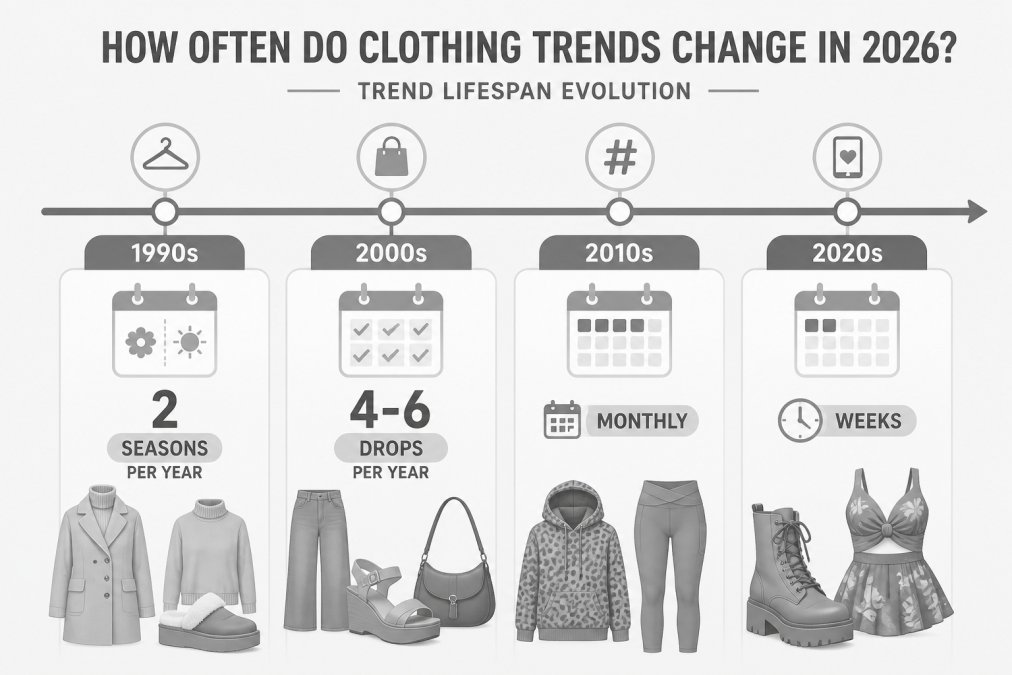
Trend cycles have compressed dramatically. The trend lifespan for a given style has shrunk from years to, in some cases, weeks.
Understanding the difference between a fad, a trend, and a classic is useful:
- Fad: A style that surges and disappears within weeks or a single season, driven heavily by social media virality.
- Trend: A style direction that holds for one to several seasons, broad enough to influence multiple product categories.
- Classic: A silhouette or piece that transcends trend cycles entirely, structured blazers, straight-leg denim, wrap dresses.
Micro-trends fueled by short-form video platforms mean fashion forecasting is now a near-real-time exercise. According to Business of Fashion's analysis of micro-trend cycles, this acceleration is reshaping how retailers approach inventory planning at every level.
For shoppers, this creates both opportunity and noise. The opportunity: more variety, more often. The noise: it's harder to build a wardrobe with lasting style identity when everything feels urgent and temporary.
Anchor your wardrobe in classics, then layer in trend pieces selectively. That approach holds up regardless of how fast the trend cycle spins.
Fast Fashion Inventory Turnover and What It Means for Shoppers
Fast fashion inventory turnover is the rate at which a retailer sells through and replaces stock. High turnover means styles move quickly off shelves; low turnover means pieces stay longer.
The appeal is obvious: constant novelty and fresh discoveries weekly appeal to trend-conscious consumers.
The hidden cost is real: High inventory turnover often correlates with lower material quality. Pieces are designed for short lifespans because the business model assumes quick replacement. According to the EPA's overview of textile waste and sustainable consumption, the fashion industry generates substantial textile waste, with fast fashion's planned obsolescence model being a significant driver.
For plus-size shoppers, rapid turnover creates additional frustration: extended sizes frequently sell out first and restock last, treated as an afterthought in the replenishment cycle. This is why seeking out retailers committed to consistent Plus Size Outfits inventory makes a real difference, it ensures your size range is part of the core restock strategy, not a secondary consideration.
What to look for instead:
- Retailers that explicitly commit to plus-size inventory as a core category
- Stores with rolling inventory additions rather than one-and-done seasonal collections
- Brands that prioritize fabric quality across all size ranges
The environmental impact of rapid inventory updates is significant. According to the Ellen MacArthur Foundation's report on circular fashion, most garments are worn far fewer times than their production cost justifies. Sustainable consumption is a smarter purchasing framework for your wardrobe and budget.
How Trendy Stores Update Smarter: A Sustainability-Focused Approach
The smartest retail replenishment strategies aren't the fastest ones, they're the most intentional ones.
Signs a retailer is updating inventory thoughtfully:
- New arrivals are announced with context
- Size ranges are consistent across new and existing inventory
- Staple pieces are restocked regularly, not just trend items
- The store doesn't discount everything within weeks of launch
- Fabric and construction details are listed clearly
Signs a retailer is chasing unit sales growth:
- New arrivals every single day with no editorial curation
- Sizes above 1X or 2X are frequently out of stock
- Prices drop sharply within two to three weeks of launch
- Product descriptions are vague about materials
Wardrobe curation pairs naturally with retailers who update on a considered schedule. Look for pieces that work across multiple contexts, not just one viral moment. According to the Sustainable Apparel Coalition's Higg Index resources, transparency in materials and production signals genuine commitment to quality over quantity.
Trendy Attic Store01 focuses on regularly adding new Plus Size Outfits, so you can check back without anxiety over one-time drops. The emphasis is on expanding selection with pieces that fit well across the size range.
Key TakeawayThe most useful question about any retailer isn't "how often do they update?" It's "how well do they update?" Frequency without intention creates noise. Look for stores that treat inventory as a curated selection, not a volume play.
Frequently Asked Questions
What days do clothing stores restock?
Most mid-tier and department stores receive shipments mid-week, typically Tuesday through Thursday, so shelves are full before weekend shopping traffic peaks. Fast fashion retailers often post new online drops on Monday or Thursday to drive early-week engagement. Curated boutiques and e-commerce shops like Trendy Attic Store01 tend to announce new arrivals without a fixed day, so following their social channels or email list is the best way to catch fresh plus-size outfits first.
How often do clothing trends change?
Trend cycles have compressed dramatically. Traditional seasonal collections changed twice a year. Fast fashion pushed that to monthly or bi-weekly drops. Today, social media micro-trends can peak and fade within two to four weeks. Wardrobe staples and classics, however, remain relevant for years. The practical takeaway: focus on versatile pieces that outlast micro-trends, and treat trend-driven items as accents rather than wardrobe foundations.
How does fast fashion impact inventory turnover rates?
Fast fashion retailers aim for extremely high inventory turnover, cycling through stock in days or weeks rather than months. This retail cadence drives consumer demand by creating urgency, but it also leads to overproduction, style fatigue, and significant textile waste. For shoppers, high turnover means frequent new options but also inconsistent sizing and quality. Choosing retailers with a more deliberate replenishment schedule often means better fabric quality and more consistent fit, especially for plus-size clothing.
How often do trendy stores update their online inventory?
Online trendy stores update inventory anywhere from weekly to monthly, depending on their merchandising strategy. Fast fashion e-commerce sites may add hundreds of new SKUs every week. Curated online boutiques typically refresh collections every two to four weeks to maintain quality control. At Trendy Attic Store01, new items are added regularly so returning shoppers consistently find fresh plus-size outfits rather than the same static selection.
This article was written using GrandRanker